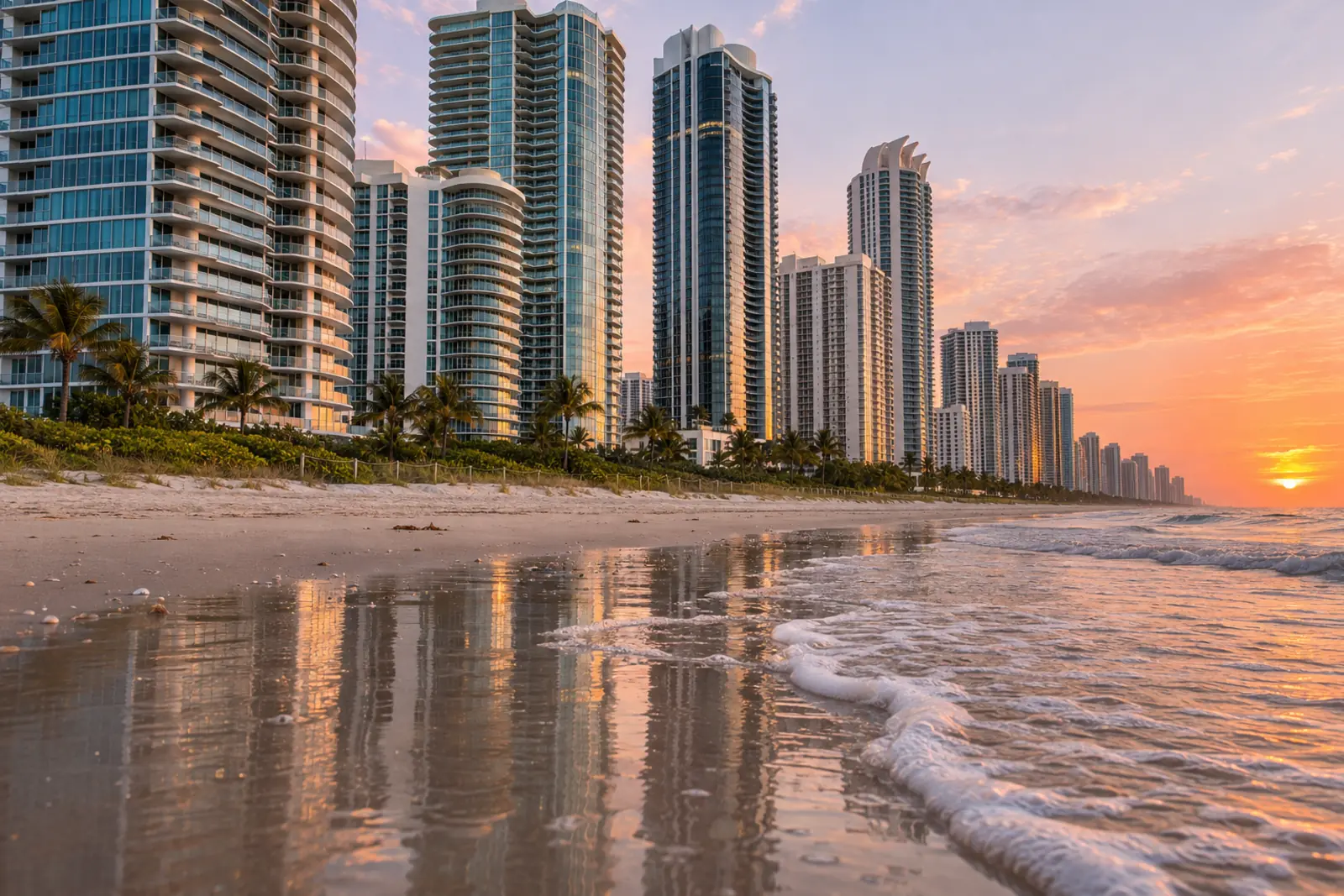
Living in Sunny Isles Beach means living on a narrow barrier island in northeastern Miami-Dade County, mostly in an oceanfront high-rise condominium, with the Atlantic on one side and the Intracoastal Waterway on the other. It suits people who want a large public beach and building amenities more than a yard, and who are comfortable with condominium rules and monthly fees. The main trade-offs are density, traffic on Collins Avenue, hurricane exposure and the cost of running an older or amenity-heavy building.
The city sits north of Haulover Park and south of Golden Beach. It has a strong concentration of both older mid-century buildings and newer towers, and a quieter residential area between the avenue and the Intracoastal. Buyers should pay close attention to building age, association finances, hurricane exposure and the amenity-heavy fee structure common in the area.
Sunny Isles Beach at a glance
- Size and population. About 1.0 square mile of land and 22,342 residents at the 2020 census, roughly 22,000 people per square mile (Wikipedia, citing Census Bureau data).
- Who lives there. The 2020 census shows a median age of 47 and about one in four residents aged 65 or older. Russian is the most commonly reported ancestry, and about 38% of residents identify as Hispanic or Latino.
- Setting. Collins Avenue (State Road A1A) is the main street. Sunny Isles Boulevard (State Road 826) leads west to North Miami Beach, and the William Lehman Causeway (State Road 856) leads west to Aventura.
- History. Residents voted to incorporate in 1997. In the early 2000s, high-rise condominiums and hotels replaced many of the one- and two-story motels that once lined Collins Avenue.
Character of the area
The city is organized around the beach and Collins Avenue. Along the ocean side, tall buildings share the shoreline and the beach is large and well used. The city maintains public spaces such as Heritage Park, Samson Oceanfront Park and Pelican Community Park, and the Newport Fishing Pier is a long-standing landmark. West of Collins, streets are lower-rise and more residential, running toward the Intracoastal Waterway and the Sunny Isles Boulevard causeway to the mainland.
Because so many residents are seasonal or international, activity levels shift through the year. Winter is busier, while summer can feel quieter. Many buildings have extensive amenities such as pools, spas and fitness areas, and those facilities are a large part of why monthly fees look the way they do.
Is Sunny Isles Beach a good place to live?
It depends on what you want from a home. The area works well for some buyers and poorly for others, and the same feature can be a plus or a minus.
What tends to work
- Direct access to a wide public beach, parks and a fishing pier, with many buildings offering their own pools and fitness facilities.
- Lock-and-leave condominium living, with building staff and shared maintenance.
- A city government with its own police department, ocean rescue and fire rescue services, plus recreation programs for children, teens, adults and seniors, according to the city's website.
- Road access to both Miami International and Fort Lauderdale-Hollywood International airports.
What to weigh carefully
- High density and congestion on Collins Avenue in the winter season.
- Monthly fees and special assessments that can rise with insurance costs and building repairs.
- Storm exposure on a low barrier island, and the insurance cost that comes with it.
- Limited detached housing. Buyers who want a house with a yard usually look elsewhere in Miami-Dade or Broward.
Sunny Isles Beach condos: housing types you will encounter
- Older oceanfront condominiums. Mid-century and 1970s to 1980s buildings, often with larger floor plans and a range of renovation levels.
- Newer luxury towers. Buildings completed in recent decades, with extensive amenities and professional management.
- Intracoastal-side buildings. Condominiums with waterway views, usually at different fee levels from oceanfront buildings.
- Single-family and townhouse pockets. A smaller portion of housing in the residential blocks west of Collins.
- Pre-construction projects. Occasionally marketed ahead of completion, which come with their own contract and deposit considerations.
Getting around
Collins Avenue is the primary road and can be congested in season. Sunny Isles Boulevard crosses the Intracoastal to the mainland and connects to the broader highway network. Miami-Dade buses serve the avenue, and the city lists a City Bus page on its website, so check current routes and schedules before relying on either. Many residents drive for most trips, though the beach, parks and some dining are walkable from nearby buildings. Both Miami International and Fort Lauderdale-Hollywood International airports are reachable by car, and some residents choose the area for that proximity.
Schools and public services, in general terms
Public schools are run by Miami-Dade County Public Schools, so confirm attendance zones through the district. The city has a K-8 public school, Norman S. Edelcup/Sunny Isles Beach K-8, which opened in 2008. High school students attend schools elsewhere in the district, and zoning can change, so verify the current assignment for a specific address. The city has its own government and police department and provides municipal services and park programs; ask for current details. Private schools and religious institutions serve the surrounding communities.
Things to check before buying a condo in Sunny Isles Beach
| Item | What to look for |
|---|---|
| Building age and inspections | Check milestone inspection status and the reserve study. See the condo guide. |
| Association finances | Review the budget, reserve balances, any loans and planned projects. |
| Assessments | Ask about special assessments past and pending, and whether the seller must pay anything before closing. |
| Insurance | Understand the master policy, wind and flood coverage and what your unit policy needs to add. |
| Fees and what they include | Compare monthly fees to the services provided, such as water, cable, security and valet. |
| Flood zone | Check the building's FEMA zone. See the flood guide. |
| Pre-construction contracts | If buying before completion, read deposit, escrow and delay provisions with a Florida real estate attorney. |
Milestone inspections and reserve studies
Florida law (section 553.899 of the Florida Statutes) requires a milestone inspection for condominium buildings of three stories or more. The first one is due by December 31 of the year the building turns 30, counted from its certificate of occupancy, and it repeats every 10 years. A local enforcement agency may require it at 25 years instead, based on local conditions such as proximity to salt water. A phase two inspection with testing is required only if phase one finds substantial structural deterioration. Section 718.112 separately requires a structural integrity reserve study at least every 10 years for residential condominium buildings of three stories or more. Ask the seller or association for the latest reports, and check with the city's building department for how the 25-year rule applies in this city, since local rules govern.
Who the area suits
Sunny Isles Beach suits people who want beach access and building amenities without needing a large garden, and who are comfortable with condominium governance. It suits less those who want a detached house with a yard. For a calmer, smaller-scale beach community nearby, read about Bal Harbour or Surfside. For a wider range of beachfront areas, see Miami Beach neighborhoods. For a comparison of the two counties, see Palm Beach County versus Miami-Dade. Buyers who plan to make a unit their permanent residence should also read about the Florida homestead exemption.
This independent guide is general information. It does not describe any specific building, and rules and conditions change. Verify with the city, county and licensed professionals.
Seasons, hurricanes and daily life
The city fills up in winter and thins out in summer, and that rhythm affects everything from restaurant hours to how crowded the elevators feel. The Atlantic hurricane season runs from June 1 through November 30, with the peak around September 10, according to the National Hurricane Center. Ask each building how it handles shutters, impact windows, generators, elevator restoration and evacuation notices. Buildings with strong storm plans and documented maintenance are easier to insure and to live in. If you plan to leave a unit empty for part of the year, ask what the rules say about absences, who inspects the unit and what the building requires before a storm.
Frequently Asked Questions
Is Sunny Isles Beach mostly condominiums?
Yes. High-rise condominiums dominate the oceanfront, with some low-rise housing and a small number of single-family blocks inland.
Why are condo fees often high there?
Fees often cover insurance, staffing, amenities, utilities and reserve contributions. Compare what is included before comparing buildings.
What is the Newport Fishing Pier?
It is a long-standing fishing pier on the beach in Sunny Isles Beach, open to visitors under its operating rules. The pier was designated a historic site in 1982, was heavily damaged by Hurricane Wilma in 2005 and reopened as the Newport Fishing Pier on June 15, 2013, according to Wikipedia.
Should I worry about building age?
Age is one factor. Maintenance history, inspection results and reserve funding matter more than year built alone. Under Florida law, buildings of three stories or more face a milestone inspection at 30 years, or 25 where the local agency requires it.
Can I buy before a tower is finished?
Yes, but pre-construction contracts carry deposit and delay risks. Have a Florida attorney review the documents before signing.
Where is Sunny Isles Beach located?
It is a barrier-island city in northeastern Miami-Dade County, between the Atlantic Ocean and the Intracoastal Waterway, with Golden Beach to the north and Haulover Park to the south.