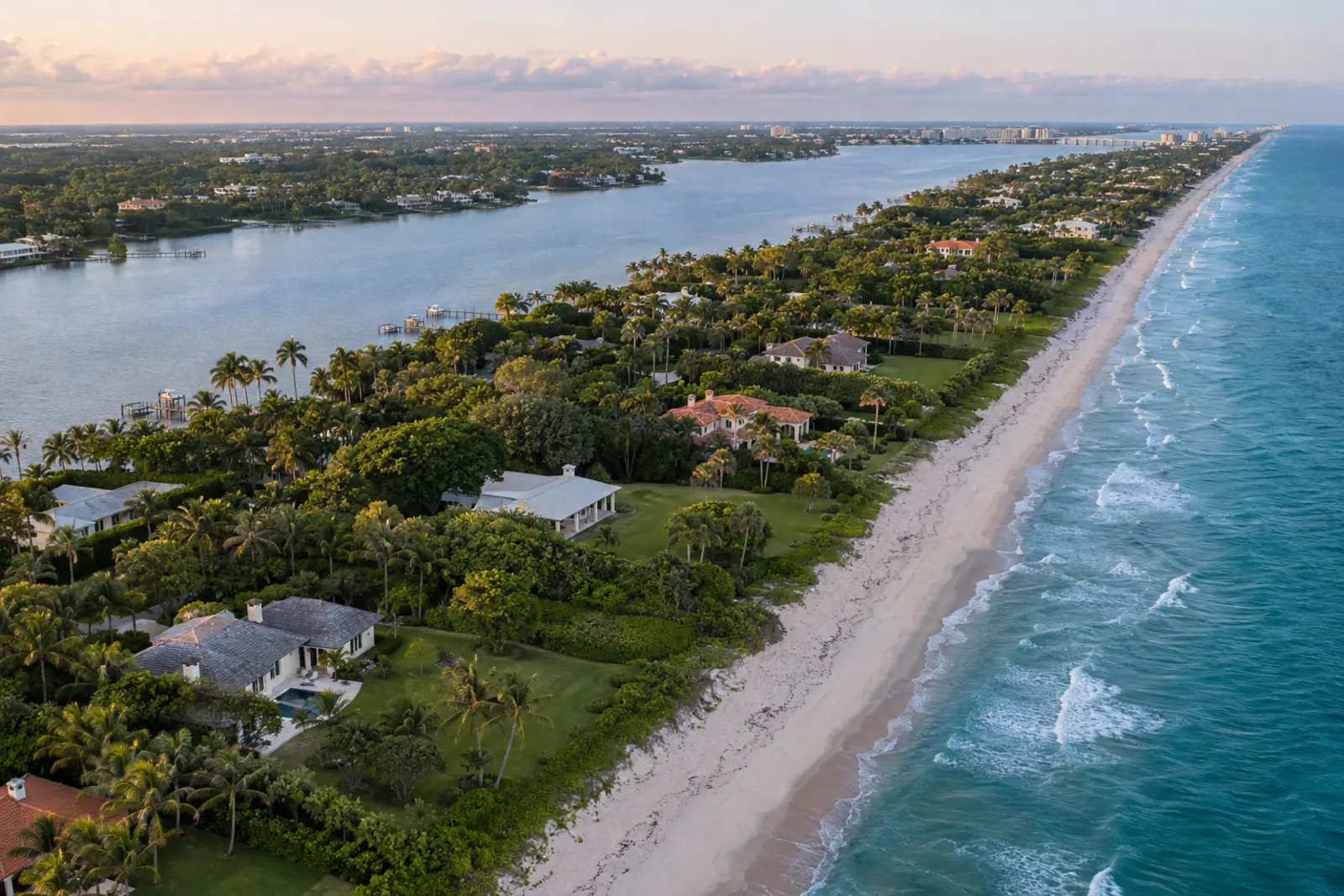
Living in Manalapan, FL means living in a very small, quiet, almost entirely residential town on a barrier island in southern Palm Beach County, with the Atlantic Ocean on the east and the Lake Worth Lagoon on the west. The 2020 census counted 419 residents. There are large oceanfront and lagoon-front lots, almost no retail, and A1A as the main road. The trade-offs are flood exposure, coastal construction rules and a drive to nearly every everyday service.
Manalapan, Florida at a glance
- Location. A barrier-island town in Palm Beach County, south of Lantana, between the Atlantic and the Lake Worth Lagoon.
- Size. 419 residents and 162 households at the 2020 census.
- Government. The town runs its own government, with Town Hall at 600 South Ocean Boulevard, open weekdays from 8 a.m. to 4 p.m. per the town's website. The town describes itself as a small and quiet community committed to controlled development and a conservative approach to government.
Character of the area
The town is a thin strip of land between ocean and lagoon. Much of the shoreline is lined with private residences, and the landscaping along A1A is dense enough that many homes are barely visible from the road. There is very little retail inside the town, so groceries, restaurants and medical offices are generally in neighboring communities on the mainland. That gives Manalapan a retreat quality that some buyers like and others find inconvenient for daily errands.
The setting is a draw in itself. The lagoon side offers boating, while the ocean side has beach frontage that is mostly private to adjacent owners. Public beach access rules differ from town to town in Florida, so anyone relying on access should check the town's current provisions rather than assuming.
Manalapan FL real estate: housing types you will encounter
- Oceanfront estates. Large houses on deep lots, many rebuilt or heavily renovated, subject to state coastal construction rules.
- Lagoon-front homes. Often with docks, seawalls and boat lifts. Seawall condition and dock permits are worth examining.
- Condominiums. A small number of low and mid-rise condo communities, some from earlier decades, with association-managed beach and pool amenities.
- Interior lots. Homes that are neither on the ocean nor on the lagoon, which tend to have different flood and wind profiles.
The market is tiny and dominated by high-value waterfront parcels, so there are few comparable sales at any one time. Prices vary widely by frontage, lot size and condition, and no single average describes the town. Compare recent closed sales for the same type of frontage, and review any local design or permit review the town applies to new construction and major renovations, which is handled through its Building and Zoning departments.
Getting around
A1A is the spine of the town. To reach the mainland you cross the lagoon on bridges in nearby communities such as Lantana, so trips to Interstate 95, shopping or Palm Beach International Airport involve planning around bridge traffic and the occasional opening. Most residents drive. Public transit is limited, and walking is pleasant for recreation but not a substitute for a car. Residents who want a more walkable day-to-day routine often compare the island with Palm Beach, which has a pedestrian commercial core.
Schools and public services, in general terms
Public schools are administered by the School District of Palm Beach County, and the attendance zone for any address should be confirmed on the district's "Find My School" boundary tool, linked from palmbeachschools.org. Private schools are available in surrounding communities.
The town has its own police department, based at Town Hall. Its listed services include vacation house checks and construction site checks outside business hours. Fire rescue is provided by Palm Beach County Fire Rescue from Station 38 at 600 S. Ocean Boulevard, according to the town's fire rescue page. Dial 911 for emergencies. Utilities and other services can differ by address, so confirm with the town and the seller who provides what at a particular property.
Things to check before buying
| Item | What to look for |
|---|---|
| Flood zone | Check the parcel on FEMA's flood map service and request an elevation certificate. Waterfront lots often carry higher-risk designations; read the flood zones guide. |
| Coastal Construction Control Line | Oceanfront building and renovation near the beach can require state permits. Ask what has been permitted at the property and whether any past work was unpermitted. |
| Seawalls and docks | Have a marine contractor review condition, and confirm dock permits are in order. |
| Wind and roof | Ask for wind mitigation reports and the roof's age. Insurers price coastal properties on these details. |
| Association rules | For condominiums and homeowner associations, review rental limits, assessments, reserves and any pending projects. |
| Building inspections | For buildings three stories or more, see the post-Surfside condo guide. |
How to look up a Manalapan flood zone
FEMA's Flood Map Service Center lets you search an address and view the National Flood Hazard Layer, and you can print a FIRMette, a small excerpt of the flood map, for the area. Pair that with an elevation certificate for the building, since insurance pricing depends on the structure's elevation as well as the mapped zone.
What the Coastal Construction Control Line means for oceanfront owners
According to the Florida Department of Environmental Protection, the Coastal Construction Control Line program exists to protect beaches and dunes from structures that are improperly sited or designed. Inside the line, special siting and design criteria apply that can be stricter than in the rest of the coastal building zone. The program's permits also help protect sea turtles and dune plants. The department's CCCL page includes a tool to locate the line for a given parcel.
Property taxes and homestead
Owners who make a home their permanent Florida residence may qualify for homestead, but the application has a deadline and residency requirements. The homestead guide explains the basics, and the Palm Beach County Property Appraiser handles the filing, including an online application. A second-home owner will not qualify for homestead on that property, which changes the tax picture significantly.
Is living in Manalapan right for you?
Manalapan suits people who value space and quiet and are comfortable driving for most services. It suits people less if they want restaurants and shops on the doorstep. If you are weighing it against a more urban or higher-density coastal option, compare it with the towers and street life covered in the Sunny Isles Beach guide, or look at how the two counties differ in the county comparison. For another small, low-density oceanfront community, this time in Miami-Dade, see Bal Harbour.
This guide is general and independent. It does not describe any particular property, and rules change, so verify with the town, the county and licensed professionals.
Frequently Asked Questions
Where is Manalapan located?
It is a town in southern Palm Beach County, on the barrier island between the Atlantic Ocean and the Lake Worth Lagoon, south of the Lantana area.
How many people live in Manalapan?
The 2020 census counted 419 residents in 162 households, up from 406 in 2010.
Are there shops and restaurants in town?
Very few. The town is primarily residential, and most everyday services are found in neighboring mainland communities.
Who provides police and fire service in Manalapan?
The town has its own police department at Town Hall, 600 South Ocean Boulevard. Fire rescue comes from Palm Beach County Fire Rescue's Station 38 at the same address, per the town's website. In an emergency, dial 911.
Is flood insurance needed in Manalapan?
Many waterfront parcels are in FEMA special flood hazard zones, where federally backed mortgages require flood insurance. Check the specific parcel's zone and get quotes either way.
Does the Coastal Construction Control Line matter?
For oceanfront property, yes. State rules regulate construction seaward of this line, so confirm past and planned work has proper permits.
Can I claim homestead on a second home?
No. Homestead applies to your permanent residence only. See the county property appraiser for exact eligibility.